
 Tweet
 Share
Many of our achievements in advancing reliable non-animal testing approaches have been rooted in the strength of our collaborative relationships, and 2025 was no different. This year, our work with new and existing partners in regulatory agencies, industry, and beyond drove progress in non-animal toxicity testing. See below for more information about these efforts, which include co-authored publications, webinars, awards, and more.
We’re pleased to share these notable highlights of the year:
- We intervened in a European Chemicals Agency Board of Appeal case, contributing to the annulment of a decision that had mandated a company to use animals in an extended one-generation reproductive toxicity study.
- Our jointly developed ‘Rethinking Carcinogenicity Assessment for Agrochemicals Project (ReCAAP)’ framework was applied to the US Environmental Protection Agency’s (US EPA’s) evaluation of two industrial chemicals, showing that additional cancer bioassays would not add value to the regulatory decision-making process.
- We launched a free searchable database of reconstructed human tissues to help researchers find commercially available organ and system tissues. Users can search by supplier, organ/system, cell type, and more.
- We progressed a multi-laboratory validation study on a respiratory irritation test that will be used to support steps towards formal guidance. The data from laboratories in the US, UK, and India will be published in 2026.
- Through our conference presentations, mentorship events, training courses, and leadership positions within scientific organisations, we continued disseminating information about reliable non-animal toxicity testing.
Publications
We published eight papers and co-authored a book chapter:
- Groff K. Increasing the use of sequence-defined antibodies: practical solutions for common targets. ALTEX. In press.
- Hilton GM, Fenner-Crisp PA, Jordan WL, Clippinger AJ, Wolf DC. Enhancing pesticide risk assessment processes at the US Environmental Protection Agency. Regul Toxicol Pharmacol. 2026;164:105959.
- Gutleb AC, Behrsing HP, Burla S, Chary A, Serchi T, Stucki AO, Ulrey A. 9.21–Advanced in vitro systems available for respiratory toxicology. In: McQueen CA, ed. Comprehensive Toxicology. 4th ed. Elsevier; 2026:436-461.
- Bhuller Y, Bishop P, Cope R, Corvaro M, Currie RA, Hilton GM, Mehta J, Puglisi R, Wolf DC, Deglin SE. Transforming the evaluation of agrochemicals: a conceptual model. Regul Toxicol Pharmacol. 2025;162:105889.
- Daniel AB, van der Zalm AJ, Raabe HA, Clippinger AJ, Choksi NY, Reinke EN, Allen DG, Kleinstreuer NC. Defined approaches to predict GHS and EPA classifications for ocular irritation potential of agrochemical formulations. Cutan Ocul Toxicol. 2025;44(3):233–249.
- Raabe H, van der Zalm A, Clippinger AJ, Costin G-E. Organizing shipping studies to evaluate the transferability of cell- and tissue-based test systems and reagents: an end user perspective. ALTEX. 2025;42(3):556-560.
- Bhuller Y, Avey M, Deonandan R, Hartung T, Hilton GM, Marles RJ, Trombetti S, Krewski D. Ethical principles for regulatory risk decision-making. Regul Toxicol Pharmacol. 2025;159:105813.
- Schür C, Paparella M, Faßbender C, Stoddart G, Baity Jesi M, Schirmer K. Daphnids can safeguard the use of alternative bioassays to the acute fish toxicity test: a focus on neurotoxicity. Environ Toxicol Chem. 2025;44(9):2635–2647.
- Sharma M, Huber E, Arnesdotter E, Behrsing HP, Bettmann A, Brandwein D, Constant S, Date R, Deshpande A, Fabian E, Gupta A, Gutierrez R, Gutleb AC, Hargrove MM, Hollings M, Hutter V, Jarabek A, Kaluzhny Y, Landsiedel R, Milchak L, Moyer RA, Murray JR, Page K, Patel M, Pearson S, Petersen EJ, Reinke E, Roldan N, Roper C, Scaglione JB, Settivari RS, Stucki AO, Verstraelen S, Wallace JL, McCullough S, Clippinger AJ. Minimum information for reporting on the TEER (trans-epithelial/endothelial electrical resistance) assay (MIRTA). Arch Toxicol. 2025;99(1):57-66.
Find a full list of our co-authored publications here.
Webinars
We launched the Eco-NAMs Webinar Series, a quarterly webinar series on the use of new approach methodologies (NAMs) for ecotoxicity assessments. The first webinar, “State of the science for bioaccumulation: an integrated, weight of evidence approach,” featured speakers from the United Kingdom Environment Agency and the Health and Environmental Sciences Institute. The series is co-organised by the European Medicines Agency, the Health and Environmental Sciences Institute, the National Institute for Environmental Studies (NIES, Japan), PETA Science Consortium International, the US EPA, and the US Food and Drug Administration.
With the Institute for In Vitro Sciences, we co-organised “NAM-based strategies for systemic toxicity assessment,” a webinar on the use of NAMs featuring speakers from the US EPA and the European Commission Joint Research Centre.
Science Consortium member PETA India organised webinars on transitioning to animal-free cell culture media and on using NAMs for the assessment of pesticides.
In December, we launched a webinar series on the use of in silico tools in toxicology. The webinars featured experts formerly serving on the contract supporting the National Toxicology Program Interagency Center for the Evaluation of Alternative Toxicological Methods (NICEATM). The presenters were partially funded by the Science Consortium to organise this event during the government shutdown and subsequent funding gap.
Recordings and presentation slides for all webinars can be found on their respective pages or by visiting our main webinars page here.
Presentations and Chaired Sessions
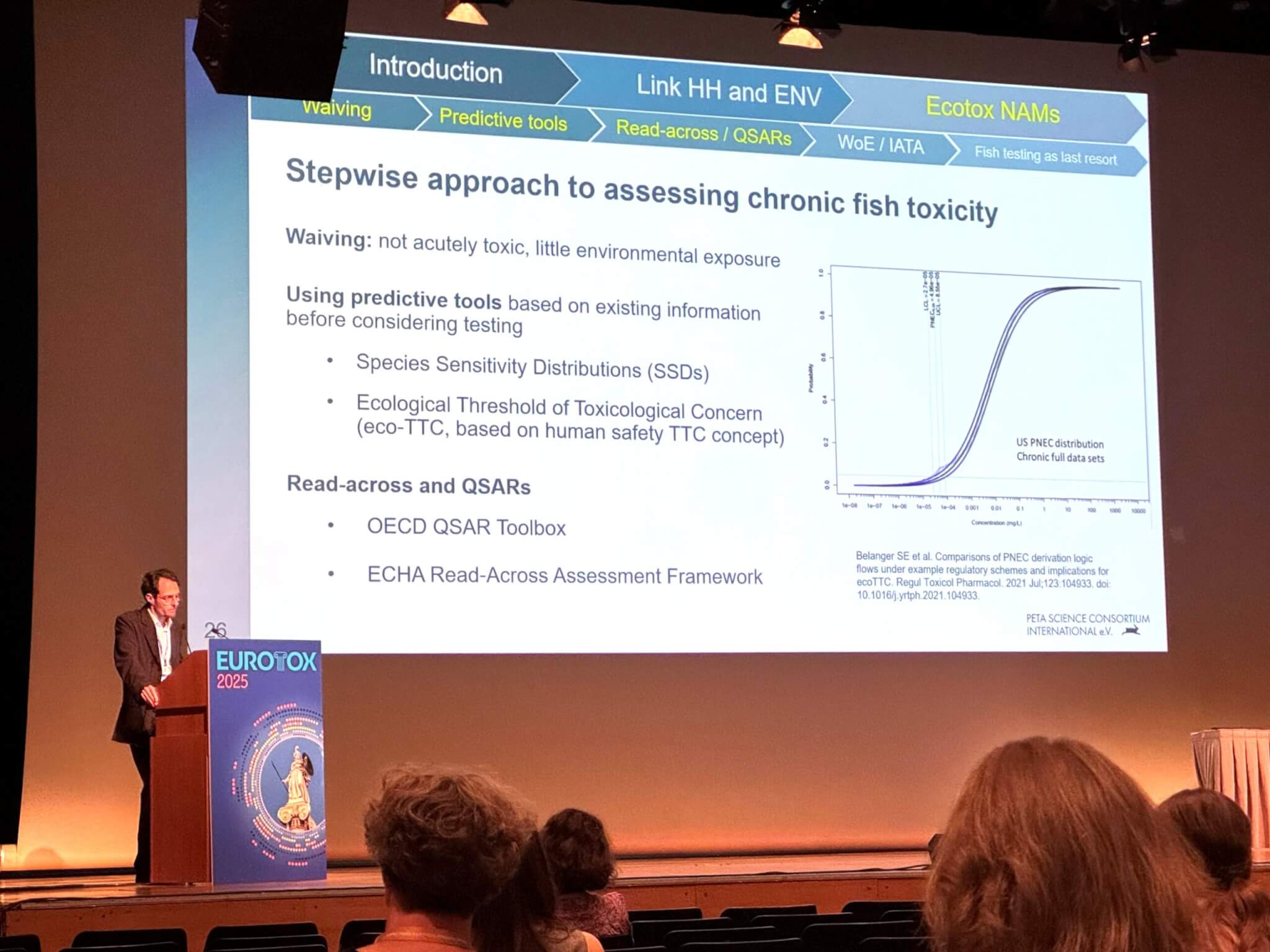
We chaired 9 sessions and delivered more than 40 oral and poster presentations at events such as the Society of Toxicology 64th Annual Meeting, the 13th World Congress on Alternatives and Animal Use in the Life Sciences (WC13), and the 59th Congress of the European Societies of Toxicology. We covered topics ranging from in vitro methods for inhalation toxicity testing to the use of frameworks to evaluate agrochemicals.
These and other select presentations can be found here.
Training
We sponsored 20 scientists from government agencies, private companies, and contract research organizations to attend the Practical Methods for In Vitro Toxicology Training workshop at the Institute for In Vitro Sciences. The course offers informative lectures and hands-on laboratory training in various toxicological endpoints such as skin and eye irritation and corrosion, skin sensitisation, phototoxicity, and respiratory toxicity. This year marked the first in our partnership with Colgate-Palmolive to sponsor scientists from India to attend a customised version of the workshop, and to subsequently host additional trainings within India.
In addition to our training events that are open to the public, we provide tailored webinars to regulatory agencies. In recent months, we facilitated and presented during training courses for regulatory agencies in the US, UK, Canada, India, and South Korea. These are highly impactful opportunities to ensure those making final decisions about whether to accept non-animal tests are informed about their availability and how to use them.
Awards Granted
We awarded a PhD candidate from the Dutch National Institute for Public Health and the Environment a travel grant to attend the European Commission Joint Research Centre Summer School on Non-Animal Approaches in Science in Italy. We also provided travel grants to scientists from the US EPA and the Brazilian Health Regulatory Agency to attend WC13 in Brazil.
We presented a postdoctoral student at Istituto Italiano di Tecnologia our Best Abstract Award for her development of animal-free hydrogel-on-chip platforms that enhance reproducibility in research. The award winner presented on this work at the June 2025 Microphysiological Systems (MPS) World Summit in Belgium.
Our funding helped support the development of a completely animal-free graduate-level biology course at Technische Universität Berlin.
Our Recombinant Antibody Challenge continued providing researchers free catalogue recombinant antibodies to test in their in vitro applications of interest instead of using animal-derived antibodies.
Leadership Positions
In addition to our existing leadership positions with Society of Toxicology committees, the Health and Environmental Sciences Institute, the Federation of European Toxicologists, and other scientific organisations, this year, we were appointed and nominated to serve in new positions with the European Society for Alternatives to Animal Testing, the European Medicines Agency, and the International Collaboration on Cosmetics Safety.



See our highlights from past years: